
The Lane Fox respiratory service cares for patients with long-term respiratory failure and who require support from a ventilator. This service is one of the largest in the UK and it enables people to be ventilated at home and for some patients to be weaned off mechanical ventilation. Initially they assess and treat people with many forms of respiratory failure and can also visit people to undertake the assessment in their home or local hospital. They liaise with primary care and local hospital services.
They work with other specialist services, particularly those caring for patients with complex neurological and neuromuscular conditions such as motor neurone disease. Their comprehensive medical team of nine consultants also includes specialist nurses, physiotherapists, speech and language therapist, dieticians, occupational therapists and important technical services for maintaining all types of ventilators.
The team is led by Prof Nicholas Hart and carries out a wide program of research looking into the aetiology of respiratory disease and constantly trying to improve the quality of treatment for patients with long-term respiratory disease.
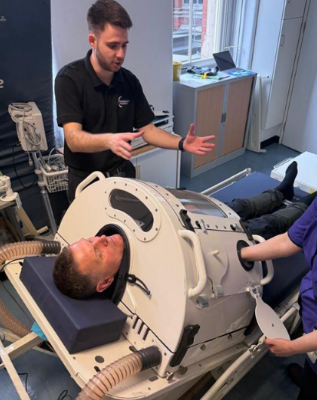
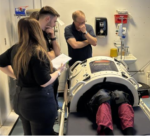
The Exovent demonstration used the first Portsmouth Aviation prototype patient enclosure powered by the Gardner Denver pump assembly and controlled by the end of phase 2C controller development. Dr Jim Roberts, our senior consultant anaesthetist, was in charge of administering CNEP (continuous negative extra-thoracic pressure) and NVP (cyclical negative pressure ventilation) to the staff who volunteered. As usual he answered all the questions and concerns raised by the volunteers and a lot of laughter and amazement ensued about how efficient and comfortable it was being ventilated in the Exovent. During the day we were fortunate to meet 24 of the Lane Fox respiratory unit team who come from a diverse range of speciality backgrounds.
Whilst many were initially hesitant because of their long-standing training and familiarity with positive pressure devices, they were quickly reassured by the excellent critical care nurses who were the first to volunteer to be ventilated. They were very positive and cheerful, thoroughly enjoying the negative pressure experience.
The feedback from all those who were ventilated was excellent and Craig Spring, Project Manager, and George Voiculescu, Project Engineer, from Portsmouth Aviation took full notes. Attendees’ thoughts and comments were also captured on an IFS document. Chelsea Thompson, Technical Officer Administrator from Portsmouth Aviation was also there to assist, together with Claire Martin, Program Coordinator of the Innovation and Industry team from Health innovation of Wessex. Claire has a truly comprehensive knowledge of innovation. Completing the team was Matt Stratton, Project Commercialisation Consultant from Coalition, who is assisting Portsmouth Aviation with many aspects of the project but particularly with a view to marketing in the future.
Important points from the feedback.
- Some of the nurses initially had concerns that required our explanation that we aimed to offer new modern negative pressure devices alongside current treatments. We are not aiming to replace positive pressure ventilation. The doctors, nurses and allied professions of the future will be able to assess which is best for individual patients with different respiratory diseases. When we discussed the possible role of Exovent in neuromuscular disease they became instantly enthusiastic.
- Long-term research will be required as patients may require respiratory support for a few days or for many decades. We will be able to offer the choice of PPV or NPV.
- Updated design changes were discussed for the patient enclosure, the pump assembly, the controller, the overall portability and use of Exovent, and finally the important aspects of finance, cleaning and maintenance.
It was interesting to hear and discuss all these points in the friendly environment of the Lane Fox Unit with all the staff and additionally pleasing to hear them echo many of the thoughts of the staff previously involved in a similar day at Southampton University Hospital.
Everyone agreed that although effort is necessary to set-up Exovent, it is no more complicated than an equivalent positive pressure device.
Further changes will be made to the current design on the basis of the excellent feedback. It will be necessary to determine a patient profile range that is achievable during early risk management activity.
Michael, the long-serving, extremely knowledgeable engineer in charge of all aspects of ventilator maintenance on the Lane-Fox unit, gave us an illuminating tour of his area and showed us the remaining old “iron lung” tank ventilator which the unit possesses. It was a truly inspiring and enjoyable visit and our sincere thanks go to everyone.
Prof. David Howard,
Attendee and Chairman, Exovent UK Charity no. 1189967


